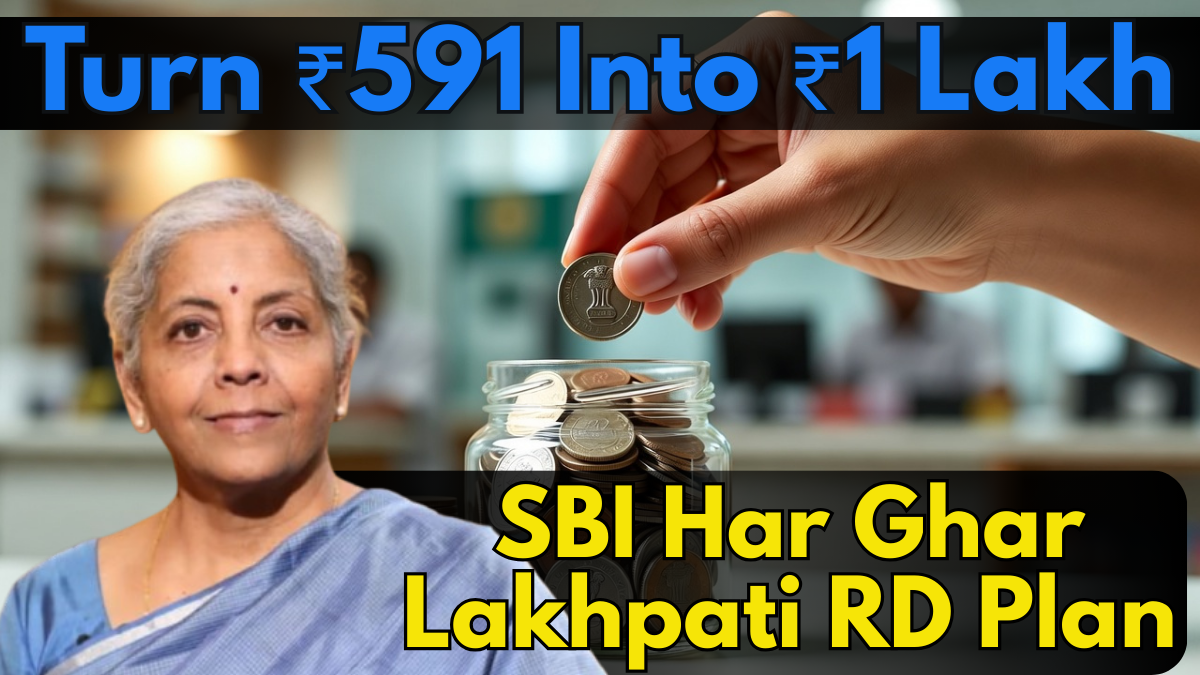
SBI’s RD Scheme 2026 under the SBI Har Ghar Lakhpati RD Plan is trending everywhere right now. Many people are asking whether it is really possible to Turn ₹591 Into ₹1 Lakh with a simple recurring deposit. You scroll social media. You see bold claims about guaranteed lakhpati status with tiny monthly saving. Your mind starts racing. Is this a genuine State Bank of India product or just hype. Because this confusion is real you need a clear guide that explains how SBI’s RD Scheme 2026 works who should use it and what returns you can expect in practical life.
In this detailed guide you will understand the structure of SBI Har Ghar Lakhpati RD Plan its benefits its risks and the real maths behind Turn ₹591 Into ₹1 Lakh. The goal is simple. You get honest information so you can decide with confidence instead of fear or FOMO.
What Is SBI’s RD Scheme 2026 Under SBI Har Ghar Lakhpati RD Plan
SBI’s RD Scheme 2026 is a special recurring deposit plan that helps you build a target corpus of about ₹1 lakh through small fixed monthly deposits. The bank calls this product SBI Har Ghar Lakhpati RD Plan. The idea is that every household can slowly become lakhpati by staying disciplined with savings.
This RD works like a normal bank recurring deposit. You choose a monthly amount and a tenure. You deposit the same amount every month. SBI pays interest at the applicable RD rate. Interest is compounded periodically. At maturity you receive your total deposits plus interest. If you choose the right combination of monthly amount and tenure that maturity can reach roughly ₹1 lakh.
Although some media headlines highlight Turn ₹591 Into ₹1 Lakh that exact figure depends on tenure and interest rate at the time you start the RD. For example public data shows that a monthly deposit of ₹591 for ten years can reach around ₹1 lakh based on recent SBI RD rates for general customers.
How SBI Har Ghar Lakhpati RD Plan Helps You Turn Small Deposits Into ₹1 Lakh
SBI Har Ghar Lakhpati RD Plan uses three simple levers.
-
Consistent monthly deposits
-
Compounding of interest over time
-
Pre calculated targets for ₹1 lakh maturity
Because the bank pre calculates combinations of tenure and monthly amount you do not need to run complex maths yourself. For example financial news analysis based on SBI data shows that
-
A regular citizen can reach about ₹1 lakh in three years with a higher monthly deposit
-
A longer tenure such as five or ten years allows lower monthly deposits
-
For the longest tenures a monthly amount near ₹591 can still grow towards ₹1 lakh maturity depending on the exact interest rate at the start
Therefore Turn ₹591 Into ₹1 Lakh is not magic. It is simply the result of disciplined saving plus compounding over a long enough period.
Key Features Of SBI’s RD Scheme 2026
Because many people get confused by fine print it helps to see the main features in one place.
-
Nature of product
-
Recurring deposit plan with fixed monthly instalment
-
-
Goal
-
Help households build a ₹1 lakh corpus or more through small savings
-
-
Tenure range
-
Minimum one year
-
Maximum ten years under SBI Har Ghar Lakhpati RD Plan variants
-
-
Minimum deposit
-
Often starts from a few hundred rupees depending on chosen slab
-
-
Interest rate
-
Same as normal SBI RD rates for the relevant tenure and category general or senior citizen
-
-
Compounding
-
Interest usually compounded quarterly as per standard RD rules
-
-
Safety
-
Backed by State Bank of India which is the largest public sector bank in India
-
Because this is an RD and not a market linked product your principal and the contracted interest rate remain protected as per bank rules. However you must still read official conditions on premature closure and penalties for missed instalments.
Can You Really Turn ₹591 Into ₹1 Lakh With SBI’s RD Scheme 2026
The headline Turn ₹591 Into ₹1 Lakh is based on specific combinations of tenure and interest rate. Public calculations based on official SBI RD tables show that
-
A general citizen investing around ₹2500 each month for three years can receive about ₹1 lakh at maturity
-
For four year tenure the deposit amount can fall near ₹1810 per month
-
For five year tenure it can drop further near ₹1407 per month
-
For very long ten year tenure the monthly amount can go down close to ₹591 while still building about ₹1 lakh maturity value
These numbers depend on prevailing interest rates such as 6.5 percent or 6.75 percent as published by SBI at the time of analysis. Therefore you should treat ₹591 as an illustration of how small amounts can work over long periods not as a fixed forever number.
Because interest rates change in future new customers may see slightly different required deposit amounts for the same maturity target. Hence you must always check the latest SBI Har Ghar Lakhpati RD Plan chart or use an official RD calculator before opening the account.
Who Should Consider SBI Har Ghar Lakhpati RD Plan
Although SBI’s RD Scheme 2026 looks attractive it suits certain types of savers more than others.
Ideal users include
-
Salaried employees who want forced monthly saving without risk
-
Homemakers who wish to build an emergency fund
-
Parents who want a small but assured future corpus for children
-
Young earners who want to learn discipline before trying higher risk products
On the other hand some people may not find this plan suitable.
-
Investors seeking very high returns from equity or crypto
-
People who need full liquidity within a few months
-
Individuals who often skip payments and cannot commit to monthly saving
Because RD is a low risk low to moderate return product it works best as a base layer of your financial plan. You can then add equity mutual funds or other growth assets on top if your risk profile allows.
Benefits Of SBI’s RD Scheme 2026
Although every financial product has limits SBI Har Ghar Lakhpati RD Plan offers several clear advantages for small savers.
-
High safety since SBI is a government backed institution with strong trust record
-
Predictable maturity value based on fixed deposit schedule
-
Easy automation through standing instructions from SBI savings account
-
Flexible tenure choices so you can match target year such as three five or ten years
-
Encouragement of savings habit because the instalment is small and regular
Moreover the scheme aligns well with financial inclusion goals. It motivates first time savers to start with a manageable figure such as ₹591 rather than waiting for large lump sums.
Important Risks And Limitations You Must Understand
Because honest financial content must highlight risk this section is very important. SBI’s RD Scheme 2026 is safe in terms of capital but it still has practical limitations.
-
Interest rate risk for new accounts
-
Future customers may get different rates than current examples
-
-
Inflation risk
-
Real buying power of ₹1 lakh may fall over long periods
-
-
Liquidity issue
-
Premature closure usually attracts penalties or lower effective return
-
-
Behaviour risk
-
Missing instalments repeatedly can lead to closure of the RD as per SBI rules
-
Therefore you should not treat Turn ₹591 Into ₹1 Lakh as a magic formula that fits every goal. Instead you should see it as one disciplined step inside a wider financial plan that also includes emergency funds proper insurance and diversified investments.
How To Open SBI Har Ghar Lakhpati RD Account Safely
Because many fraudulent links and fake offers float online you must follow only official channels.
You can open SBI’s RD Scheme 2026 through
-
Any SBI branch by visiting with KYC documents
-
SBI official internet banking portal if you already have a savings account
-
SBI YONO mobile app which supports RD account opening for many users
Before you sign the form you should check
-
The exact monthly instalment
-
The tenure in months
-
The maturity value shown on the screen or form
-
The applicable interest rate and compounding frequency
-
Rules on premature closure and penalties for default
Because this is your hard earned money you should keep a copy or screenshot of the RD details for reference.
Practical Tips To Use SBI’s RD Scheme 2026 Wisely
Finally here are some practical tips that combine expert guidance with ground reality.
-
Start with an amount you can sustain without stress even during tough months
-
Align the tenure with a specific goal such as school fee or gadget or travel fund
-
Set an auto debit date just after salary credit to reduce missed instalments
-
Review your RD and other savings once a year to track progress
-
Add other growth assets over time so that you do not rely only on fixed income products
Because SBI Har Ghar Lakhpati RD Plan is stable and predictable it works very well as the base for such a layered strategy.
Official Website of SBI
Conclusion
SBI’s RD Scheme 2026 under SBI Har Ghar Lakhpati RD Plan offers a clear and disciplined path to build a ₹1 lakh corpus through small monthly savings. The popular line Turn ₹591 Into ₹1 Lakh is based on genuine RD calculations for longer tenures and current interest rates not on any lottery or risky scheme. However interest rates and exact figures may change in future so you must always check the latest official chart or calculator before investing. When you use this plan as part of a balanced financial strategy SBI’s RD Scheme 2026 can become a powerful tool for safe and predictable wealth building for regular Indian households.
DISCLAMIER
Premature closure is allowed as per SBI’s official Har Ghar Lakhpati RD rules. Early closure attracts a penalty on interest and for very early closure you may receive only principal. Therefore you should always confirm the current lock-in and penalty conditions on SBI’s official site or in branch before opening the account.
For More Information Click HERE