Every year, as the sun slowly rises over New Delhi on Republic Day 26 January, millions of eyes turn towards the national flag and the grand parade. Because the visuals look so impressive, many people feel curious about the real story behind this date. Therefore, in this article, you will discover why India celebrates Republic Day on 26 January, how the Constitution was created, and why this historic moment still shapes Indian life today. Moreover, the explanation stays simple and clear so that students, competitive exam aspirants, and general readers can all understand it easily.
Why 26 January Was Chosen For Republic Day
Although India won independence on 15 August 1947, leaders decided that the Constitution would start working on 26 January 1950. Therefore, the date was not random at all.
Firstly, the Indian National Congress had declared Purna Swaraj, or complete independence, on 26 January 1930. Because this day already carried emotional and political power, the leaders wanted to link the new Constitution to that earlier promise. Consequently, when the Constitution was adopted in November 1949, they fixed 26 January 1950 as the enforcement date. As a result, the same date now marks both the dream of full freedom and its final fulfilment.
How The Constitution Of India Was Made
The Role Of The Constituent Assembly
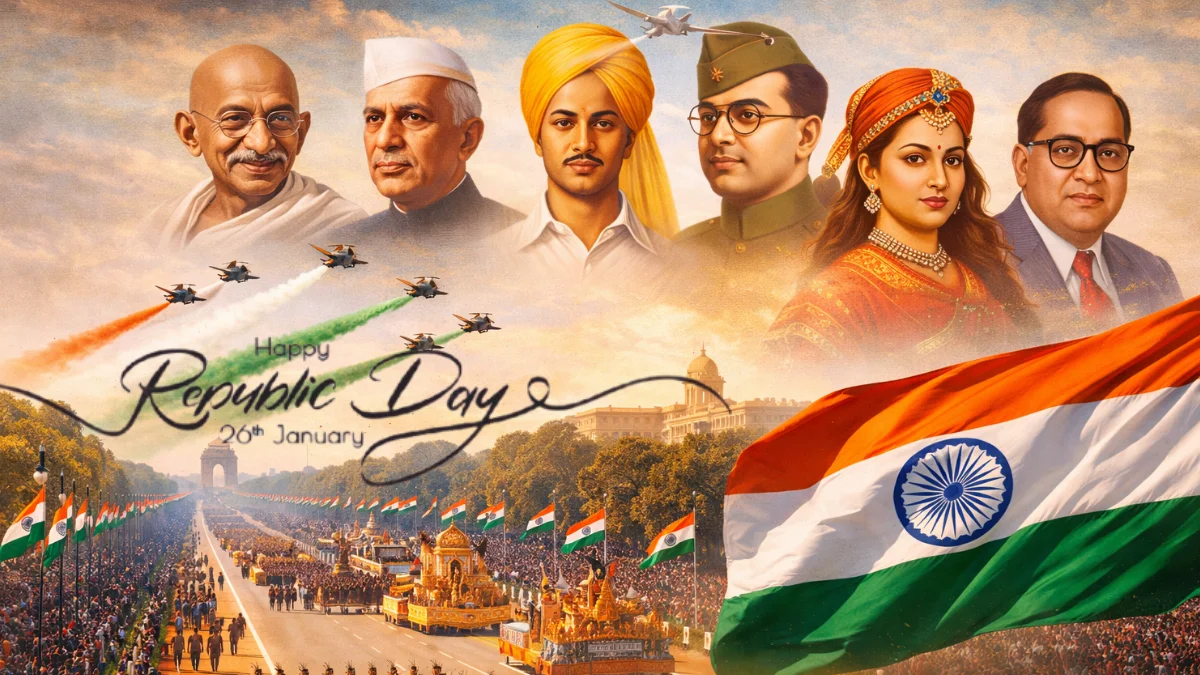
Right after independence, a Constituent Assembly took charge of framing the Constitution. Because the task demanded deep knowledge and balance, the Assembly created a Drafting Committee. Dr. B.R. Ambedkar became its Chairman, and leaders such as Jawaharlal Nehru, Sardar Vallabhbhai Patel, Dr. Rajendra Prasad, and Maulana Abul Kalam Azad played key roles. Therefore, many viewpoints came together during the drafting process.
Long Debates And Careful Study
The Assembly worked for almost three years, discussing every clause. Moreover, the members studied several foreign constitutions, including those of the United States, the United Kingdom, Ireland, and others, to learn good practices. However, they did not copy blindly. Instead, they adapted ideas to suit India’s social, cultural, and political realities. Consequently, the final document reflected both global experience and Indian needs.
Adoption And Enforcement
The Constitution was adopted on 26 November 1949. However, it only came into force on 26 January 1950. Because of this, India officially became a republic, and the office of the President of India replaced the British monarch as head of state. From that date, the Constitution became the supreme law of the land.
What Actually Changed On Republic Day
On the surface, people saw new flags, new ceremonies, and a new President. However, the deeper changes were much more important.
Firstly, India stopped using the Government of India Act 1935 as the main framework. Therefore, the country no longer depended on laws built for a colony. Instead, the Constitution of India took over and provided a democratic structure with clear separation of powers between the legislature, executive, and judiciary.
Secondly, citizens received Fundamental Rights, such as the right to equality, the right to freedom, and the right to constitutional remedies. Because of these rights, people could challenge unfair actions and demand justice. Moreover, the Constitution included Directive Principles of State Policy, which guide the government in creating welfare policies.
As a result, 26 January 1950 stands as the day when Indians not only lived in a free country but also started living under their own, carefully designed system of law and governance.
How India Celebrates Republic Day Today
The Grand Parade In New Delhi
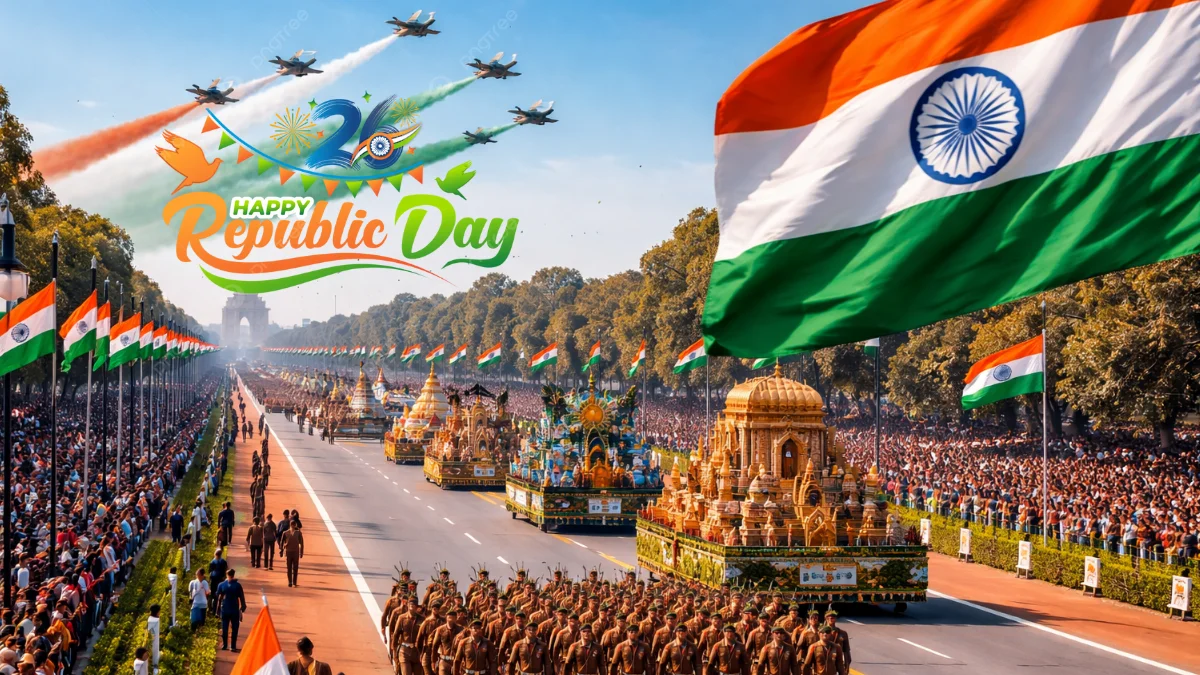
Every year, the main Republic Day celebration takes place at Kartavya Path in New Delhi. During the parade, the President of India unfurls the national flag and receives a salute from the armed forces. Moreover, marching contingents from the Army, Navy, and Air Force display discipline and strength. Tanks, missiles, aircraft formations, and defence systems also move past the audience, showing India’s military capabilities.
In addition, colourful tableaux from different states and union territories present local culture, festivals, and achievements. Therefore, the parade becomes a living showcase of India’s diversity.
Foreign Chief Guest
Almost every year, India invites a foreign head of state or government as the Chief Guest. Because of this, the event also acts as a platform for strengthening international relationships and diplomatic ties.
Republic Day Across The Country
At the same time, schools, colleges, housing societies, and government offices across India celebrate the day with flag hoisting, speeches, patriotic songs, and cultural programs. Moreover, children often take part in skits and parades that highlight the freedom struggle and the importance of the Constitution.
Gallantry Awards And Beating Retreat
On this occasion, the Government of India also announces gallantry awards to recognise brave soldiers and civilians. Later, on 29 January, the Beating Retreat Ceremony at Vijay Chowk brings the Republic Day celebrations to a formal close with military bands performing in a solemn and beautiful atmosphere.
Why Republic Day Still Matters For Young India
In today’s fast changing world, some people may treat Republic Day as just another holiday. However, the day still carries strong meaning, especially for the younger generation.
Because the Constitution provides rights, protections, and duties, it shapes every area of life, from voting and education to freedom of speech and equality before law. Therefore, understanding Republic Day helps young citizens see how their daily freedoms exist due to decisions taken in 1950. Moreover, the celebration reminds everyone that democracy needs active, informed, and responsible citizens to stay strong.
In conclusion, 26 January is not only a date from the past. Instead, it is a living reminder that India chose to follow the path of democracy, justice, and equality, guided by one of the most detailed constitutions in the world.
Official Government
Because factual accuracy matters, you can always cross check Republic Day information on these official sites:
-
National Portal of India: https://india.gov.in
-
Ministry of Defence of India: https://mod.gov.in
Both websites often publish reliable details about Republic Day events, history, and official programs.
Conclusion
In conclusion, Republic Day continues to shape India’s identity because it reminds the nation of the moment it embraced its own Constitution and democratic rights. Moreover, the day highlights how freedom becomes meaningful only when citizens participate responsibly. Therefore, 26 January remains a powerful symbol of unity, justice, and national pride, inspiring every generation to protect the values that built modern India.
For More Information Click HERE