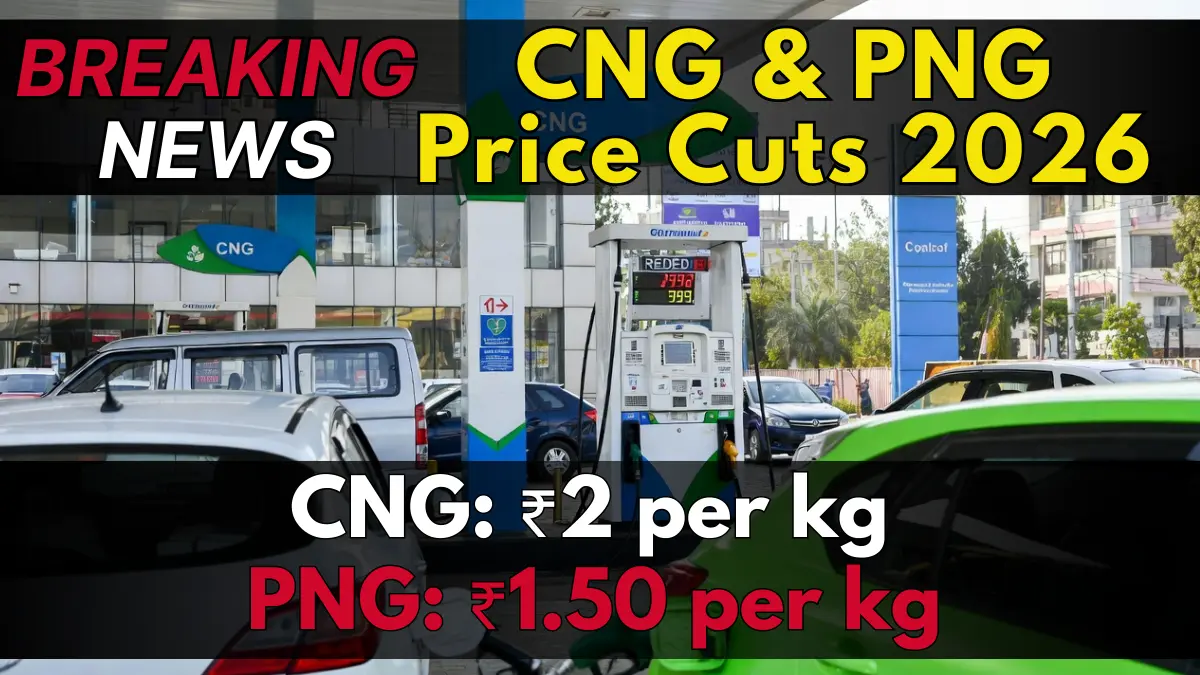
Breaking news has brought much-needed relief to millions of Indian families. CNG and PNG prices have been reduced across multiple cities, directly lowering monthly fuel and cooking expenses. Meanwhile, this development comes at a crucial time when household budgets remain under pressure. As a result, vehicle owners using compressed natural gas and families dependent on piped gas can expect meaningful annual savings. Importantly, the CNG & PNG Price Cuts 2026 have already taken effect in cities such as Delhi, Mumbai, and Gujarat, meaning the benefits begin immediately rather than gradually.
What Are CNG and PNG Price Cuts in 2026?
CNG (Compressed Natural Gas) and PNG (Piped Natural Gas) price cuts refer to reductions in the retail prices charged to consumers for transportation fuel and domestic cooking gas. Typically, these revisions are announced by city gas distribution companies after reviewing input costs, government policies, and broader energy market conditions.
More importantly, understanding these price cuts matters because:
- CNG fuels lakhs of vehicles, especially autos, taxis, and private cars
- PNG is a primary cooking fuel for urban households
- Price changes directly impact monthly expenses
- Lower rates indicate favourable energy market trends
- Savings compound steadily over time
Consequently, companies such as Indraprastha Gas Limited, Mahanagar Gas Limited, and Gujarat Gas regularly revise prices whenever costs decline.
Latest CNG & PNG Price Cuts Across India in 2026
In early 2026, several major cities witnessed notable reductions in both CNG and PNG prices. As a result, consumers across regions are already experiencing lower fuel bills.
Delhi NCR
To begin with, Delhi NCR saw price cuts announced by IGL. Consequently, CNG prices dropped by ₹2 per kg, while PNG rates declined by ₹1.50 per SCM. Therefore, auto drivers and households alike benefit immediately.
Mumbai Metropolitan Region
Similarly, MGL reduced CNG prices by ₹2.50 per kg. At the same time, PNG rates for households were cut by ₹1.50 per SCM. As a result, over 15 lakh PNG users in Mumbai now enjoy lower monthly bills.
Gujarat Cities
Meanwhile, Gujarat Gas announced reductions across cities like Ahmedabad, Surat, and Vadodara. While CNG prices fell by ₹2 per kg, PNG rates dropped by ₹1 per SCM. Consequently, lakhs of households benefit statewide.
Other Cities
Additionally, cities such as Pune, Lucknow, Kanpur, and Bengaluru also saw similar reductions. Although the quantum varied slightly, the direction remained consistent nationwide.
Why Are CNG and PNG Prices Falling?
Understanding the reasons behind these cuts helps consumers predict future trends and plan energy choices more effectively.
Decline in Global Gas Prices
Firstly, international natural gas prices have softened due to higher supply and moderate demand. Therefore, India’s LNG import costs declined. As a result, distribution companies were able to pass on benefits to consumers.
Stable Exchange Rate
Secondly, the Indian Rupee remained relatively stable against the US Dollar. Consequently, LNG imports became cheaper, lowering the landed cost of gas.
Rising Domestic Production
Meanwhile, domestic gas production from fields like the KG Basin improved steadily. Additionally, new extraction technologies increased output. Hence, reduced import dependence helped stabilise prices.
Government Policy Support
Furthermore, government measures such as tax rationalisation and infrastructure expansion reduced operational costs. Therefore, distribution efficiency improved across regions.
Lower Crude Oil Prices
Although indirectly linked, softer crude oil prices created favourable energy market conditions. Consequently, gas pricing also benefited.
Latest CNG & PNG Prices: City-Wise Examples
Delhi NCR
CNG
- Old: ₹75.61/kg
- New: ₹73.61/kg
- Monthly saving (15 kg): ₹30
PNG
- Old: ₹48.50/SCM
- New: ₹47.00/SCM
- Monthly saving (30 SCM): ₹45
Mumbai
CNG
- Old: ₹77.00/kg
- New: ₹74.50/kg
- Monthly saving: ₹37.50
PNG
- Old: ₹49.50/SCM
- New: ₹48.00/SCM
- Monthly saving: ₹45
Gujarat
CNG
- Old: ₹72.00/kg
- New: ₹70.00/kg
- Monthly saving: ₹30
PNG
- Old: ₹46.00/SCM
- New: ₹45.00/SCM
- Monthly saving: ₹30
LPG vs PNG: What About Cooking Gas?
While CNG and PNG prices declined, LPG prices follow a different pattern. Typically, LPG prices depend on international propane and butane benchmarks rather than natural gas trends.
Recently, commercial LPG rates dipped marginally. However, subsidised domestic LPG prices remained largely stable due to government intervention. Therefore, PNG continues to be the cheaper and more convenient option for urban households with access.
How These Price Cuts Impact Your Budget
For CNG Vehicle Owners
Auto and taxi drivers consuming 10–15 kg daily can save ₹600–₹1,125 monthly. Consequently, this directly boosts earnings. Similarly, private car owners save ₹60–₹100 per month, which adds up annually.
For PNG Households
Households using 25–35 SCM monthly save ₹25–₹52.50. Although modest monthly, the annual impact is meaningful. Moreover, PNG eliminates cylinder booking hassles and ensures uninterrupted supply.
What Consumers Should Do Now
Vehicle Owners
If you haven’t switched to CNG yet, this is an ideal time. Additionally, evaluate station availability and calculate long-term savings. Meanwhile, existing users should maintain vehicles properly to maximise efficiency.
Households
Likewise, LPG users should check PNG availability in their area. Furthermore, comparing connection costs with long-term savings helps make informed decisions. Additionally, using efficient burners reduces wastage.
How to Stay Updated on Prices
To stay informed, register for alerts on official gas company websites. Furthermore, follow verified social media accounts and monitor government announcements regularly.
Official CNG & PNG price page – Indraprastha Gas Limited (IGL)
https://www.iglonline.net/cng-png-prices
Conclusion
The CNG & PNG Price Cuts 2026 provide timely relief to Indian households and commuters alike. With reductions of ₹1 to ₹2.50 across major cities, both vehicle owners and families benefit from lower monthly expenses. While LPG prices remain relatively stable, PNG continues to be a cost-effective and convenient alternative. Ultimately, these cuts are driven by lower global gas prices, increased domestic production, and supportive government policies. Therefore, consumers should leverage the opportunity, track usage, and stay updated to maximize long-term savings.
For More Information Click HERE