The 8th Pay Commission latest news today has become the hottest topic for over 1 crore central government employees and pensioners across India who are counting down the days until this commission transforms their financial lives forever. Your salary could see a massive jump of Rs 15,000 to Rs 25,000 per month very soon, and it is not just wishful thinking.
Right now, Twitter is exploding with 8th Pay Commission hike latest news, WhatsApp groups are flooded with leaked salary charts, and YouTube is full of 8th Pay Commission salary calculator videos, but here is the problem. Most of this information is either misleading, outdated, or completely fake, leaving employees confused about what is really happening.
If you are tired of scrolling through unreliable sources and want the complete truth about the 8th Pay Commission 2026, you have come to the right place. In this detailed guide, we will break down everything you need to know about when will 8th Pay Commission start, how much salary hike you can realistically expect, what the new salary calculator reveals, and most importantly, how the 8th Pay Commission for pensioners will benefit retired employees. No rumors, no speculation, just facts backed by official sources and historical patterns. Let us dive straight into the most important financial update of 2026 that will impact millions of government families.
8th Pay Commission Latest News Today
The 8th Pay Commission dominates discussions among central government employees, pensioners, and their families. The 7th Pay Commission rolled out in January 2016. Speculation about the 8th Pay Commission gained momentum from 2023 onwards. As we move through 2026, anticipation has reached its peak. Employees desperately seek clarity on implementation timelines and expected benefits.
The Government of India has not issued any official notification about the 8th Pay Commission yet. The Ministry of Finance has not released any formal circular. The Department of Expenditure has not published any order establishing the commission. However, history shows Pay Commissions typically arrive every 10 years.
The 7th Pay Commission started from January 1, 2016. This means the next logical timeline for the 8th Pay Commission would be around January 2026 or shortly thereafter. Employee unions have started submitting memorandums to the government. They demand early constitution of the commission. They want substantial salary increases to match inflation and rising living costs.
When Will 8th Pay Commission Start
Understanding the timeline helps set realistic expectations about when salary benefits will reach your bank account.
Historical Pattern of Pay Commissions
Every Pay Commission in India follows a similar timeline. The government first constitutes the commission. The commission then spends 18 to 24 months studying salary structures. After the commission submits its report, the government reviews it. The government modifies recommendations if needed. Finally, the government accepts the recommendations.
The government usually sets the implementation date retrospectively. For instance, the government constituted the 7th Pay Commission in February 2014. The commission submitted its report in November 2015. The government implemented it from January 1, 2016. Following this pattern, if the government constitutes the 8th Pay Commission in 2026, employees can expect implementation by 2028 or early 2029.
Current Status and Expected Timeline
No official announcement has come about constituting the 8th Pay Commission as of January 2026. Employee unions push for an early announcement. They argue that the 10 year cycle from the 7th Pay Commission has completed. The government’s decision depends on multiple factors:
- Fiscal situation and budget constraints
- Economic growth rate and inflation
- Overall government expenditure priorities
- Revenue collection and deficit management
The commission could arrive anytime between mid 2026 to early 2027. Once constituted, the commission needs at least 18 to 24 months to complete its work. This means actual salary implementation is likely between 2028 to 2029. Employees will receive arrears from the official implementation date.
8th Pay Commission Expected Salary Hike
Every government employee wants to know how much their salary will increase.
Fitment Factor Explained
The fitment factor multiplies your existing basic pay to calculate new basic pay. The 6th Pay Commission used a fitment factor of 1.86. The 7th Pay Commission used 2.57. This means if your basic pay was Rs 10,000 under the 6th Pay Commission, it became Rs 25,700 under the 7th Pay Commission.
Employee unions demand a fitment factor of 3.68 for the 8th Pay Commission. If approved, this would boost salaries significantly. For example, if your current basic pay is Rs 18,000, it would become Rs 66,240 under the proposed fitment factor. However, the government may choose a more conservative number considering fiscal constraints.
Realistic Salary Increase Expectations
Expert analysis suggests the 8th Pay Commission will offer a fitment factor between 2.8 to 3.2. Here is what this means:
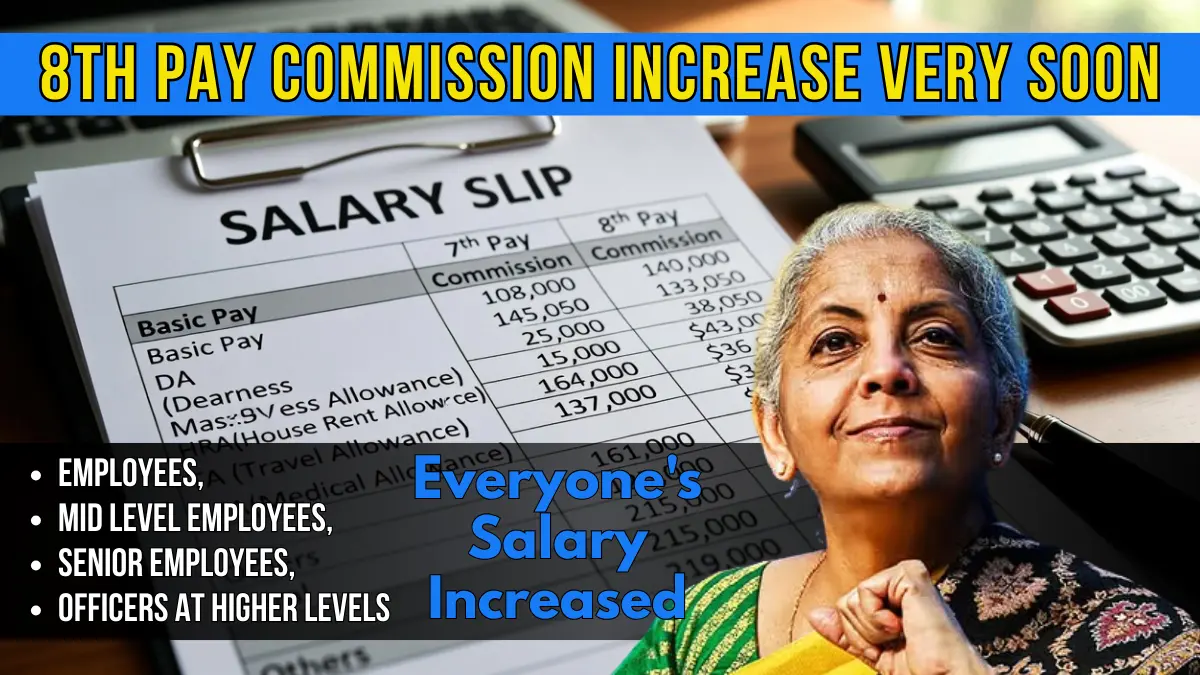
- Employees with current basic pay of Rs 18,000 can expect new basic pay between Rs 50,400 to Rs 57,600.
- Mid level employees with basic pay of Rs 40,000 could see their basic increase to Rs 112,000 to Rs 128,000. This results in a take home salary hike of Rs 15,000 to Rs 20,000 per month.
- Senior employees with basic pay of Rs 70,000 might get revised basic pay of Rs 196,000 to Rs 224,000. Their overall salary increase would be Rs 25,000 to Rs 35,000 monthly.
- Officers at higher levels with basic pay above Rs 1,00,000 could see proportionate increases. This significantly boosts their overall compensation package.
These are preliminary estimates based on assumed fitment factors. The actual increase depends on the commission’s final recommendations and government approval.
8th Pay Commission Salary Calculator
Understanding how to calculate your expected salary helps in better financial planning.
How to Calculate Your New Salary
You can make preliminary calculations using the expected fitment factor. The basic formula is simple. New Basic Pay equals Current Basic Pay multiplied by Fitment Factor.
For example, your current basic pay is Rs 25,000. Assume a fitment factor of 3.0. Your new basic pay would be Rs 75,000. To this basic pay, add various allowances. These include Dearness Allowance, House Rent Allowance, Transport Allowance, and other special allowances.
Dearness Allowance calculates as a percentage of basic pay. It changes every six months based on inflation indices. HRA depends on the city classification where you work:
- Metro cities get 27 percent of basic pay as HRA
- Other cities get 18 percent of basic pay as HRA
- Smaller towns get 9 percent of basic pay as HRA
Components of Salary Structure
Your total salary comprises multiple components beyond basic pay:
- Basic Pay forms the foundation. The fitment factor directly affects this amount. All other allowances calculate based on basic pay.
- Dearness Allowance compensates for inflation. The government revises it twice yearly. Currently it stands at around 50 percent of basic pay.
- House Rent Allowance varies based on city classification. This allowance significantly impacts your take home salary.
- Transport Allowance covers commuting expenses. The government has standardized this amount in recent years.
- Special Allowances apply to specific categories. Medical professionals, teachers, and technical staff receive these based on their job requirements.
Once the commission announces recommendations, online calculators will appear on government portals. Various employee welfare websites will also provide these tools.
8th Pay Commission Benefits for Pensioners
Retired government employees form a significant beneficiary group. The 8th Pay Commission will bring substantial relief to pensioners.
Expected Pension Hike
Pensioners will benefit from the fitment factor applied to their basic pension amount. A pensioner currently receives Rs 20,000 as basic pension. If the government applies a fitment factor of 3.0, the revised basic pension becomes Rs 60,000. This substantial increase helps pensioners cope with rising healthcare costs, inflation, and living expenses.
The commission will likely review and enhance various pensioner benefits:
- Dearness Relief for pensioners will continue linking with Dearness Allowance for serving employees. This ensures pensioners benefit equally from inflation adjustments.
- Medical facilities and reimbursement limits may increase. Rising healthcare costs particularly affect senior citizens.
- Family pension rules could become more liberal. This provides better support to dependent family members of deceased pensioners.
- Pension revision for pre 2006 pensioners has been a long standing demand. The commission may recommend parity measures.
Arrears for Pensioners
Pensioners will receive arrears just like serving employees. The arrears start from the official implementation date. If the implementation date is January 1, 2028, and the final notification comes in June 2028, pensioners receive six months of arrears. This lump sum payment can be substantial. Pensioners can use this for healthcare, family needs, or savings.
Official Government Portals for Updates
Stay connected with authentic sources. This prevents falling prey to misinformation and fake news on social media.
Verified Information Sources
Always check these official portals for authentic updates:
- Department of Expenditure: https://doe.gov.in/ (Primary source for all Pay Commission notifications, orders, and official updates)
- Ministry of Finance: https://www.finmin.nic.in/ (Official announcements regarding Pay Commission constitution and budgetary approvals)
- Department of Pension: https://dopw.gov.in/ (Specific information for pensioners regarding revised pension calculations and benefits)
- Press Information Bureau: https://pib.gov.in/ (Government press releases and official statements on Pay Commission developments)
Never trust unverified claims on Twitter, Facebook, WhatsApp groups, or YouTube channels. Many fake notifications circulate on social media. These create unnecessary excitement or panic among employees. Always cross verify any news with official government portals before believing or sharing information.
If you see trending hashtags on Twitter about 8th Pay Commission announcements, check the PIB website. Verify with the Department of Expenditure portal for official confirmation. Government announcements always come through proper channels with official orders and circulars.
What Employees Should Do Right Now
While waiting for official announcements, government employees can take proactive steps.
Prepare Your Financial Planning
Start planning how you will utilize the increased salary. Consider these priorities:
- Pay off high interest debts first to reduce your financial burden
- Increase your monthly SIP investments or recurring deposits
- Build a stronger retirement corpus for long term security
- Review your insurance coverage and upgrade health insurance
- Consider rising medical costs in your planning
Do not make major financial commitments based on expected salary hike. Avoid taking large loans assuming your salary will increase soon. The implementation timeline may vary from current expectations. Maintain financial discipline.
Stay Informed Through Official Channels
Subscribe to email alerts from Department of Expenditure and Ministry of Finance websites. Follow official government Twitter handles rather than unofficial news pages. Join recognized employee unions that have direct communication with the government. These organizations share verified information with members.
Participate constructively in employee welfare associations and staff federations. These organizations represent employee demands to the government. They ensure that legitimate concerns get addressed during the Pay Commission deliberations.
Conclusion
The 8th Pay Commission represents hope for better financial stability. Over 1 crore central government employees and pensioners await this change. The exact implementation date and salary hike percentage remain uncertain until official announcements arrive. However, historical patterns suggest we are approaching the timeline when the government should constitute the commission.
Employees can realistically expect a fitment factor between 2.8 to 3.2. This results in substantial salary increases. These increases will significantly improve living standards. Pensioners will equally benefit from revised pension calculations and enhanced benefits. The key is to stay patient. Rely only on official information sources. Avoid getting swayed by unverified social media rumors.
As we progress through 2026, keep monitoring official government portals for authentic updates. The wait has been long. But when the 8th Pay Commission finally becomes reality, it will bring meaningful financial relief. Government employees and pensioners rightfully deserve this after years of dedicated service to the nation.
For More Information Click HERE